LangLearn: Language learning
- 4.5
- Rating
- 100.00K
- Installs
- Free
- Price

 Analysis by App-foxy
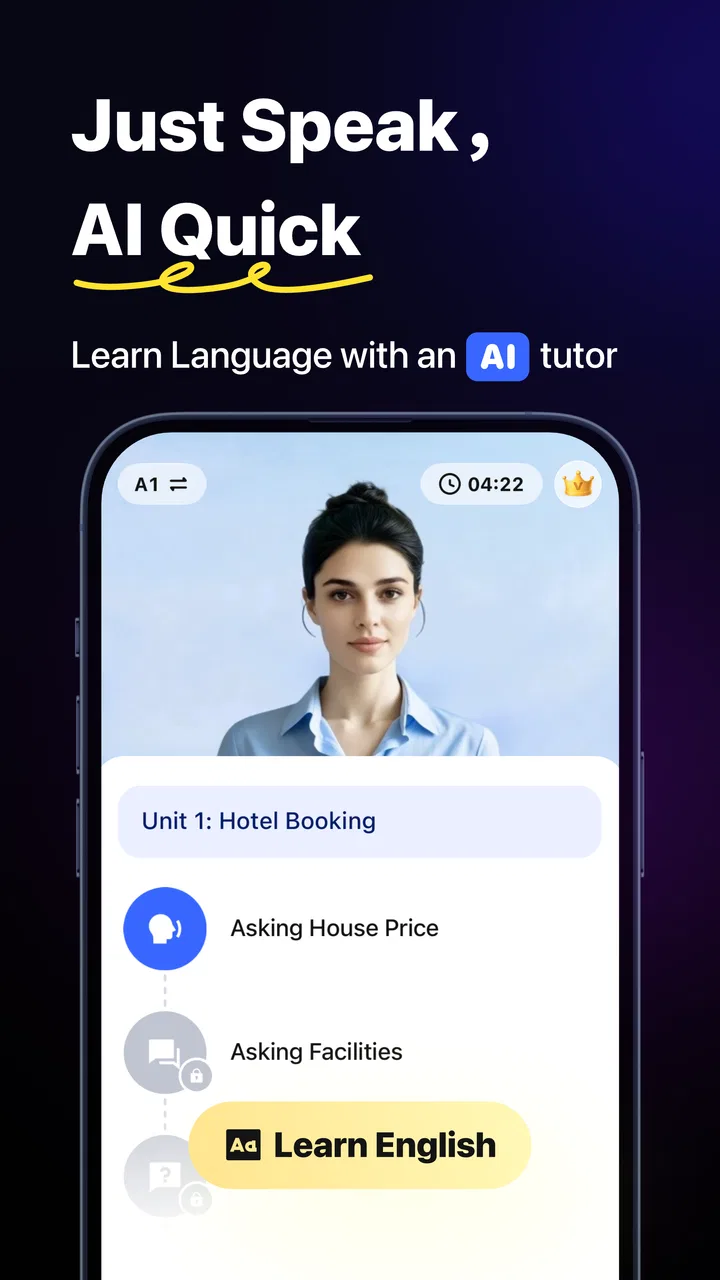
I spent time with LangLearn as an education app for language practice, and my first impression is that it aims to make learning feel less tied to a desk or a fixed lesson schedule. Its central idea is the use of artificial intelligence to support language learning whenever you have a spare moment. That makes it appealing for people who want something more flexible than a traditional course, especially when their routine changes from day to day.
What makes this app worth examining closely is not simply the promise of learning anywhere. Many language tools make a similar promise. The more useful question is whether LangLearn fits the way you actually study, whether its free access is enough to build a habit, and whether paying adds enough value to justify moving beyond other familiar options. My view is positive but measured: it can be a convenient starting point, yet it should be treated as a practice companion rather than a complete replacement for every part of language education.
How LangLearn fits into everyday language study
LangLearn is developed by mqcoder and is listed as a free app for Android. It is aimed at a general audience, with an Everyone content rating, so its positioning is broad rather than focused on a particular age group, profession, or exam. The app reached its current version, 1.3.1, after being released on August 13, 2025, and it requires Android 9 or later.
You May Also Like

 Blood Strike: 2.5 Anniversary
Blood Strike’s Loadouts Turn Every Drop Into a Tactical Gamble
A close look at Blood Strike’s custom loadouts: how fast access to signature weapons reshapes its battle royale rhythm, rewards preparation, and narrows the gap between fights.

 Pandora - Music & Podcasts
Pandora’s Music Is Easy to Start, but Harder to Recover
Pandora’s strength is its low-effort path from a seed to a station. Its weak spot is how much confidence it asks you to place in connection, setup, and quiet recovery.

 8 Ball Pool
 Is Built on Rivalries, Rematches, and Routine
A close look at the rivalries, rematches, shared routines, and unanswered safety questions that turn a quick pool match into a persistent mobile community.

 Samsung Music
’s Quiet Strength Is Playing What You Already Own
Its reach comes less from spectacle than from dependable access to a personal library. That simplicity is both the app’s strongest retention engine and its ceiling.

 AccuWeather: Weather Radar
AccuWeather Review: A Quick, Clear Forecast for Everyday Decisions
For everyday plans, the best forecast is the one you can understand quickly. AccuWeather makes rain timing, radar, and local conditions easy to act on, with a few trade-offs.

 Hill Climb Racing
Why Hill Climb Racing Still Turns Crashes Into One More Run
A tiny car, a bumpy hill and one more upgrade: Hill Climb Racing keeps resurfacing because its simple chaos makes every near-miss feel personal.
More From Our News Desk



That Android requirement matters in practical terms. Anyone using a reasonably modern phone should find the compatibility range manageable, while people holding on to older devices may need to check their operating system before planning around the app. I also like that the basic entry point is free, because language learning is easier to try when the first decision is not a financial commitment.
The app has built a visible user base, with over one hundred thousand installs and an average rating of 4.5 from around two thousand seven hundred ratings. Those figures suggest that LangLearn has attracted meaningful interest and that many users have responded well to it. They are not a guarantee that it will suit every learner, though. A language app can feel excellent to someone seeking casual daily practice and disappointing to someone expecting a full academic curriculum.
In my experience, the most sensible way to approach LangLearn is to give it a defined role. I would use it for short practice sessions, experimenting with explanations, reviewing weak areas, or getting started when I do not have the energy for a formal lesson. I would not rely on any single AI-based tool as my only source of grammar guidance, pronunciation feedback, cultural context, or structured progression.
The free starting point and what paid access means
The app itself is free to download, but it includes in-app purchases ranging from $6.99 to $59.99 per item. That is an important distinction: trying LangLearn does not require paying upfront, while deeper or expanded access may involve a purchase. The different price points also mean that the value question cannot be answered with a simple “free” or “paid” label. The right decision depends on what the free experience lets you do and whether the paid option solves a problem you actually have.
I would begin without spending anything. Use the free access long enough to answer practical questions: Does the learning style keep me interested? Are the explanations clear enough for my level? Does the AI help me notice mistakes, or does it produce answers that still need checking? Can I fit it into my normal day without feeling that opening the app has become another obligation?
Only after those questions have clear answers would I consider an in-app purchase. The lower listed purchase point may be reasonable for someone who uses the app consistently and finds that added access improves their routine. The highest listed price deserves more caution. It represents a much larger commitment, so I would compare the app with a structured course, a tutor, or another language platform before choosing it. The existence of a higher-priced item does not by itself prove that the extra value will matter to every learner.
There is also a psychological advantage to starting free. New learners often confuse enthusiasm with a sustainable habit. Paying immediately can create pressure to continue even when the method is not a good match. LangLearn lets you test the routine first, which is the right order for an app whose usefulness depends heavily on personal consistency.
What value an AI language companion can provide
The strongest potential benefit is flexibility. A conventional class normally asks you to appear at a certain time and follow a predetermined pace. A textbook gives you reliable structure, but it does not respond to every question in the moment. LangLearn occupies a middle space: it can be available when your schedule allows and may feel more interactive than reading a static page.
That flexibility is especially useful in small gaps. Imagine that I have ten minutes before an appointment. I can use that time to revisit a phrase, ask for an explanation in simpler language, or test whether I understand a sentence. A short session is not enough to master a language, but it is much better than waiting for a perfect hour that rarely appears. The app’s anytime approach makes those small sessions feel legitimate rather than incomplete.
Another useful workflow is to use it after encountering language elsewhere. If I read a message, watch a video, or hear a phrase that confuses me, an AI learning tool can become a place to unpack the problem while it is still fresh. I would write down the exact phrase, ask what role each part plays, and then create a few variations of my own. This turns passive exposure into active practice, which is more valuable than simply collecting vocabulary.
There is a subtle trade-off here. AI can make explanations feel personal, but personalization is only helpful when the explanation is accurate and appropriate for the learner’s level. If an answer sounds confident but misses an exception, a beginner may absorb the wrong pattern. I would therefore treat LangLearn’s explanations as useful working guidance, not as an unquestionable authority. For important grammar points, formal reference material or a qualified teacher remains the safer final check.
How I would build a practical routine
I would not open the app without a purpose and simply wander through whatever appears first. A better routine is to assign each session one job. On one day, I might focus on understanding a confusing construction. On another, I could practice turning familiar words into complete sentences. A third session could be used to review mistakes from earlier practice rather than constantly chasing new material.
One non-obvious advantage of this approach is that it reduces the temptation to measure progress only by how much new content I have seen. Language ability grows through retrieval, correction, and reuse. If LangLearn helps me return to a difficult phrase until I can produce it without assistance, that session may be more valuable than a longer session filled with unfamiliar examples.
I would also keep a small external note of recurring errors. This is not a criticism of the app; it is a way to prevent AI practice from becoming disposable conversation. After several sessions, I could group mistakes under headings such as word order, verb forms, articles, or prepositions. Then I would bring one group back into the app and ask for focused practice. That workflow makes the tool more deliberate and gives me a way to judge whether it is genuinely helping.
For travelers, the most useful routine may be scenario-based. Before a trip, I would practice a narrow set of situations such as ordering food, asking for directions, checking into accommodation, or handling a misunderstanding. The goal would not be to memorize isolated phrases. I would ask for variations, polite alternatives, and ways to recover when the other person answers unexpectedly. That last part is important because real conversations rarely follow the exact script prepared at home.
For a student, I would use LangLearn alongside class notes rather than instead of them. After a lesson, I could ask for additional examples using the same grammar and then try to explain the rule in my own words. If my explanation is weak, that tells me what to revisit. This turns the app into a revision partner while keeping the teacher or course as the main source of sequence and accountability.
Where it compares well with familiar alternatives
Compared with a textbook, LangLearn is likely to feel more responsive and less rigid. A book is excellent when I want a carefully edited progression that I can revisit without depending on an AI response. It is less convenient when I have a very specific question that does not fit the current chapter. LangLearn’s advantage is immediacy; the textbook’s advantage is stability and editorial control.
Compared with a classroom, the app is more private and flexible. I can practice a basic sentence repeatedly without worrying about slowing down other students. On the other hand, a class provides a real teacher, peer interaction, and a schedule that pushes me to show up. If I repeatedly postpone independent study, the flexibility that attracts me to LangLearn may become its weakness.
Compared with a human tutor, LangLearn is more convenient for frequent low-pressure practice, while a tutor is better positioned to notice patterns across time, adapt to subtle misunderstandings, and provide natural conversation. I would choose the app for preparation and repetition, then use a tutor or conversation partner when I need authentic interaction and nuanced correction.
Compared with a traditional flashcard app, LangLearn appears better suited to questions and contextual practice than to a purely memorization-driven routine. Flashcards can be faster for drilling a known vocabulary list, especially when I want precise repetition. An AI companion becomes more useful when I need to understand why a phrase works, generate variations, or connect words in a situation. Neither approach fully replaces the other.
Limitations I would consider before paying
The first limitation is that convenience can be mistaken for completeness. An app that responds to prompts may help me practice, but it does not automatically provide a balanced curriculum. I still need to make sure I am developing vocabulary, grammar, listening, reading, writing, and real conversational ability rather than repeatedly practicing the easiest area.
The second limitation is quality control. AI-generated language help can be useful, but learners should remain alert to awkward wording, missing context, or explanations that simplify a rule too much. This matters most for beginners, who may not yet have enough knowledge to recognize a questionable answer. I would cross-check anything central to an exam, professional communication, or a sensitive conversation.
A third issue is motivation. LangLearn may remove barriers to starting a session, but it cannot guarantee that I will continue using it. Someone who needs a fixed syllabus, progress deadlines, or direct human accountability may get better results from a course or tutor. The free model makes experimentation easy, but it does not solve the personal discipline problem that affects almost every self-study method.
People who want advanced, highly specialized language training should also be selective. If the goal is a formal qualification, industry-specific terminology, or detailed feedback on long writing, I would not assume that a general education app can cover every requirement. It may still be useful for supplementary practice, but the main resource should match the exact outcome I need.
Who is most likely to get real value
I think LangLearn is a good fit for curious beginners who want a low-risk way to start, as well as intermediate learners who already know the basics and need more opportunities to use them. It can also suit busy adults, travelers preparing for common situations, and students who want an additional way to review material between lessons.
It is particularly attractive to people who dislike rigid study plans but still want more interaction than a static phrasebook provides. The ability to practice in short bursts can make language learning feel compatible with commuting, breaks, or quiet time at home. I would still recommend choosing a recurring time or trigger, such as using the app after breakfast or after reviewing class notes, because convenience alone does not create consistency.
I would be more cautious about recommending it as the main tool for someone who has never studied independently and does not know how to judge an explanation. That learner may benefit from a teacher, a well-structured beginner course, or a textbook that establishes a dependable foundation. LangLearn can then become a helpful supplement once the learner has enough context to question and verify what they see.
I would also skip it, or keep it strictly secondary, if I wanted guaranteed human conversation. AI practice can prepare me for speaking, but preparation is not the same as interacting with another person who has their own accent, habits, speed, and unexpected responses. For that goal, a tutor, class, or conversation exchange is the better primary choice.
My buy-or-skip verdict
My recommendation is to try LangLearn free first and judge it by a specific routine rather than by a single impressive session. Give it a real task: clarify a grammar point, prepare for a travel situation, review repeated mistakes, or turn new vocabulary into usable sentences. If it helps me practice more often and understand my errors more clearly, it is delivering meaningful value even before I consider paying.
I would consider an in-app purchase only when the free experience has become part of my routine and I know exactly what additional access I am buying. The listed purchase range runs from $6.99 to $59.99 per item, so the lower commitment and the highest commitment should not be treated as equivalent decisions. I would be comfortable evaluating the smaller purchase against my actual usage; I would scrutinize the larger one and compare it with a course or tutor first.
Overall, LangLearn earns a place on my shortlist because it offers a flexible, approachable way to add AI-supported practice to everyday life. Its four-point-five average from around two thousand seven hundred ratings and its audience of over one hundred thousand installs show that it has found a receptive user base, but my final judgment is more personal: the app is most valuable when it turns spare minutes into focused practice, not when it is expected to teach everything by itself.
So I would recommend installing it to learners who want an adaptable starting point or a convenient practice partner. I would skip paying immediately, and I would not use it as my only resource for serious academic or professional goals. Used with clear objectives, occasional fact-checking, and another source of real language exposure, LangLearn can be a sensible free-first choice. Used without a plan, it risks becoming another app I open with good intentions and abandon when the novelty fades.
FAQs for LangLearn: Language learning
01What is LangLearn: Language learning, and who is it designed for?
LangLearn: Language learning is a mobile app designed to help users study and practice a foreign language through short, interactive lessons. It can be useful for complete beginners, casual learners, travelers, and students who want extra practice outside a classroom. The app is generally most effective for building vocabulary and maintaining a daily study routine, rather than replacing a complete language course or conversation teacher.
02Which languages can I learn with LangLearn?
The languages available in LangLearn may depend on the version of the app, your device, and the developer’s current catalog. Before downloading, check the app’s official store listing to confirm that your preferred language is supported. It is also worth checking which learning directions are offered, since some languages may have more complete vocabulary, pronunciation, grammar, or exercise content than others.
03Does LangLearn require an internet connection to work?
LangLearn may require an internet connection for downloading lessons, synchronizing progress, displaying advertisements, or accessing certain features. Some content could remain available offline after it has been downloaded, but offline access should not be assumed for every exercise or language course. If you plan to study while traveling, open the required lessons in advance and verify what remains accessible without mobile data or Wi-Fi.
04Is LangLearn free to download and use?
LangLearn can typically be downloaded without an upfront charge, but the free version may include advertisements, limitations on lessons, or restricted access to advanced features. Depending on the current release, the app may also offer in-app purchases or a subscription. Review the pricing screen carefully before confirming payment, especially for trial periods, automatic renewal terms, and cancellation instructions managed through Google Play or the App Store.
05Can LangLearn help me become fluent in a language?
LangLearn can be a practical tool for learning common words, reviewing phrases, and developing a consistent study habit, but an app alone is unlikely to provide complete fluency. Real progress also requires listening to natural speech, practicing pronunciation, learning grammar in context, reading, writing, and having conversations. Use LangLearn as part of a broader routine, and treat its exercises as supplementary practice rather than a complete language-learning program.
Pros
- Short lessons make it easy to study during breaks.
- Covers useful everyday vocabulary for practical conversations.
- Progress tracking helps maintain a consistent learning routine.
- Audio exercises support pronunciation and listening practice.
- Suitable for beginners who prefer a simple learning experience.
Cons
- Advanced learners may find the content too limited.
- Some lessons can feel repetitive after extended use.
- Offline access may be restricted or unavailable for some content.
- Certain features may require a subscription or in-app purchase.
- Speech exercises may not recognize every accent accurately.

LangLearn: Language learning
Gallery